How a Stylist’s Creative Vision Becomes a Property’s Competitive Advantage
Introduction
There is a version of this industry where styling is a finishing touch in a property marketing campaign. Where the stylist arrives after every other decision has been made, fills the rooms with furniture, and leaves before the photography crew sets up.
Then there is the version where the stylist enters the campaign as a decision maker, reading the property, interrogating the styling brief, building a creative response that translates architecture into aspiration, and aspiration into offers. Where every furniture selection, every layer, every photographic moment is a deliberate decision in service of a specific buyer outcome.
If you are already working at this level, what follows will validate and sharpen how you articulate what you do.
If you are building toward it, use this article as a framework for the practice, and the language, that separates strategic stylists and wins jobs.

The Styling Brief as Strategy
Every strong campaign begins before a single piece of furniture is selected. It begins with a question most stylists underuse:
Who is the buyer we are staging for, and what do they need to feel?
This is not a rhetorical question. It is the foundation of every decision that follows, and it requires real information and market research to answer well.
What does a strategic styling brief looks like in practice?
Before the first site visit, a strategic stylist gathers:
- The agent’s read on the likely buyer profile (family upgrader, downsizer, investor, prestige owner-occupier)
- The property’s price point and how it sits within the current suburb median
- The campaign format (auction, private treaty, expressions of interest) and its timeline
- Any known competing listings in the area and how they are presenting
- The vendor’s personal goals (speed, price, or both) and their tolerance for bold creative decisions
This last point matters more than most stylists acknowledge. A vendor who needs to sell in three weeks requires a different creative approach than one running a six-week prestige campaign. Understanding the commercial constraint shapes the creative brief as much as the architecture does.
The buyer profile question:
At a $1.5M price point in an inner-east Brisbane suburb, the likely buyer is a family upgrader: educated, design-aware, time-poor, motivated by liveability and school catchments. They respond to warmth, practicality signalled through considered layout, and a sense of “move-in readiness.”
At a $4M+ price point in a prestige suburb, the buyer is evaluating identity and aspiration first. They are not asking “can I live here?” They are asking “does this reflect who I am?”
The creative response to those two styling briefs should be unique.
Reading the Property as a Stylist
The site visit is more than a measurement exercise.
A strategic stylist arrives at a property ready to run diagnostics, and is looking for three things simultaneously: its assets, its liabilities, and its story.
Assets are the features that will generate emotional response in the target buyer. This could be the ceiling height, the natural light, the architectural detail, the view. These are the moments the staging must amplify and the photography must capture to make a property stand out from the crowd.
Liabilities are the features that will generate hesitation such as dated elements, or spatial ambiguity in an unusual floorplan. These are the problems staging must solve, not by hiding them, but by redirecting the buyer’s attention and emotional investment, before they become anchors.
The story is the through-line that connects the property’s best qualities into a coherent narrative, through the styling brief. Every home has one, though it is not always obvious at first read. The story might be “relaxed sophistication for a family that entertains” or “architectural ambition made liveable” or “the coastal escape that happens to be twelve minutes from the CBD.” The story is what the staging communicates, and it should be articulable in a single sentence.
THE BARDON PRINCIPLE
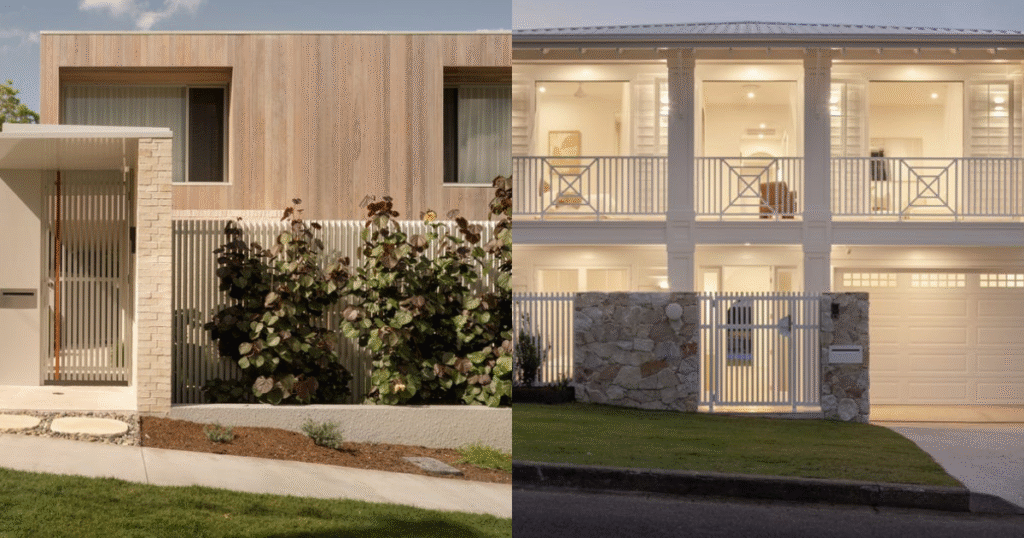
The Bardon architectural home referenced in our Case Study presented a specific challenge:
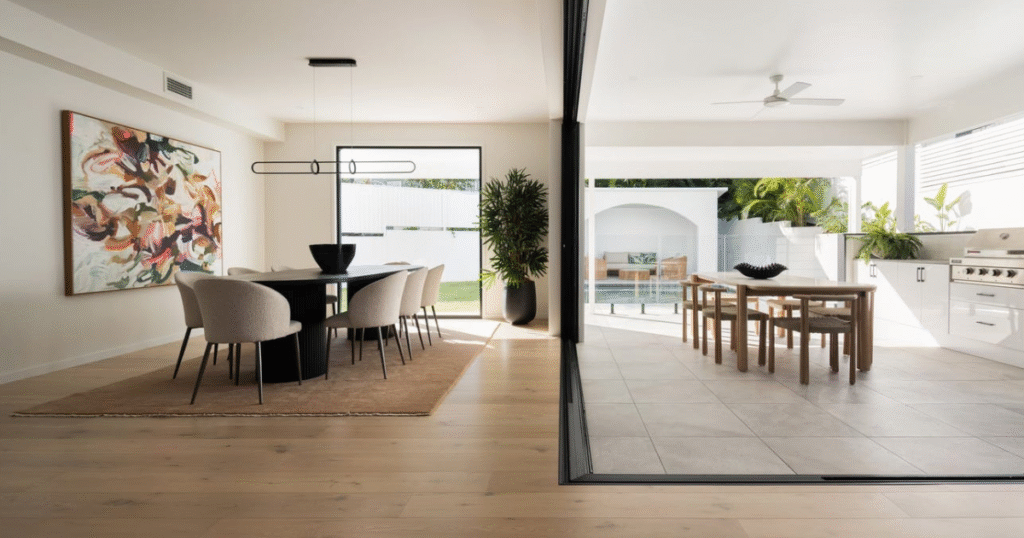
A complex floorplan required buyers to understand spatial relationships that weren’t intuitively readable. The story of “architectural ambition translated into lived aspiration” dictated every creative decision that followed, from furniture scale to the sequencing of visual moments through the home. The result was a sale significantly above the estimated price range.
The Mood Board as a Strategic Document
The mood board is widely misunderstood, both by stylists who treat it as a Pinterest exercise and by vendors who see it as purely a decorative preview.
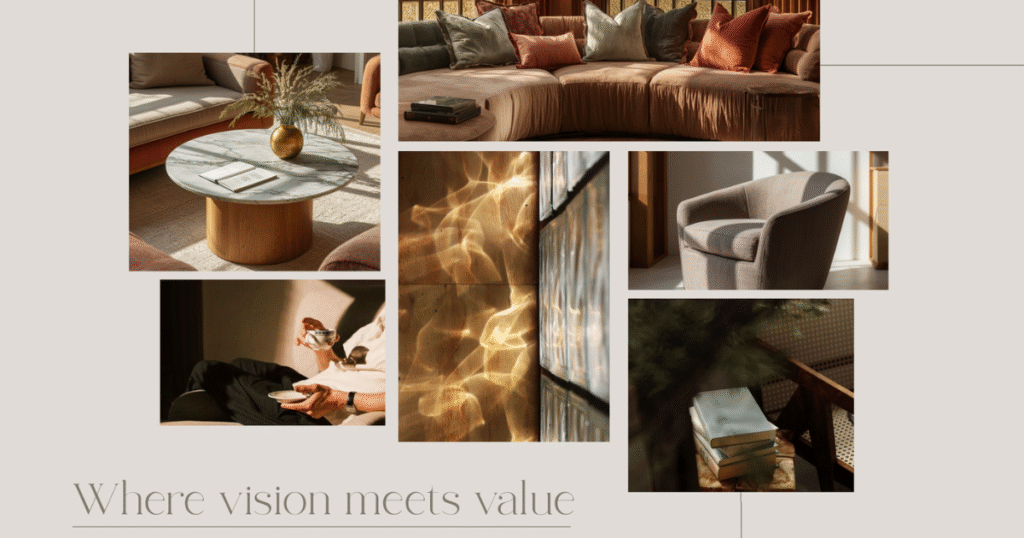
A strategic mood board communicates the creative direction clearly enough that every subsequent decision, can be tested against it.
It answers the question: does this choice serve the story?
What a strategic mood board should contain:
A buyer reference image. Not a picture of a trending couch, a picture of the life the target buyer aspires to. This might be an editorial image or cinematic shot from a sunlit reading nook, a restaurant interior, or spa-like bathroom. Whatever communicates the emotional register the home needs to inhabit. This image anchors every decision that follows.
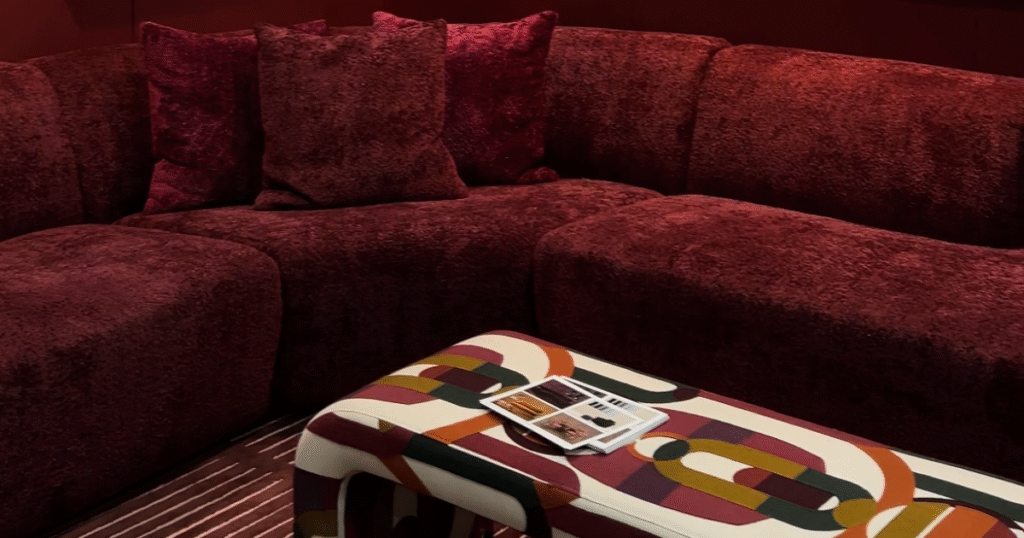
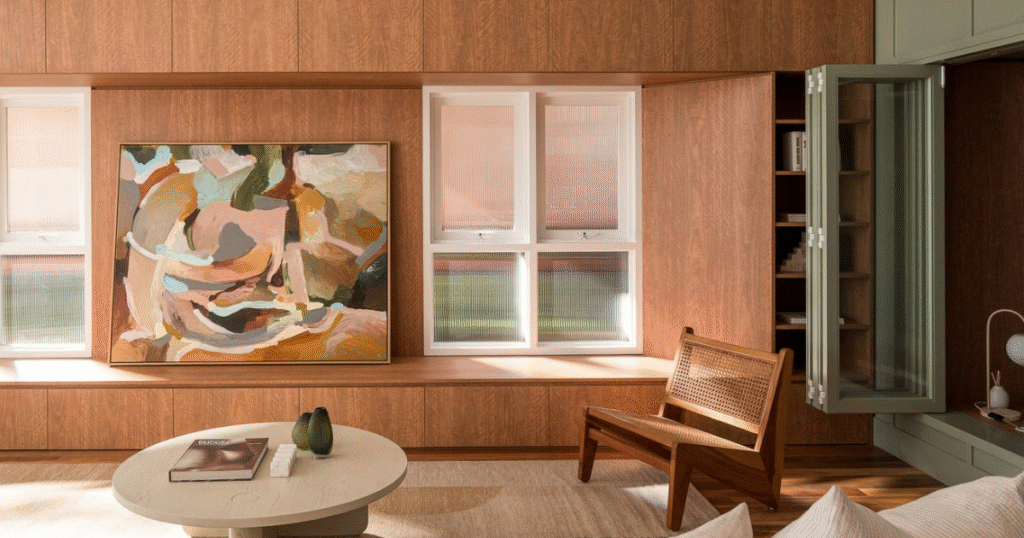
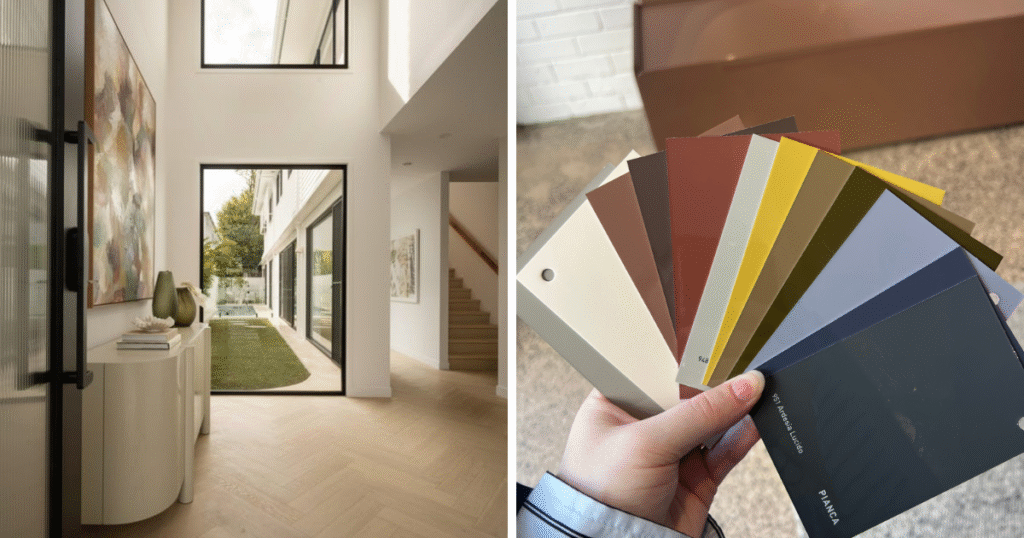
A material and texture direction. Warm versus cool, matte versus reflective, organic versus refined. This direction prevents the incoherence that happens when individually beautiful pieces fail to read as a unified environment.
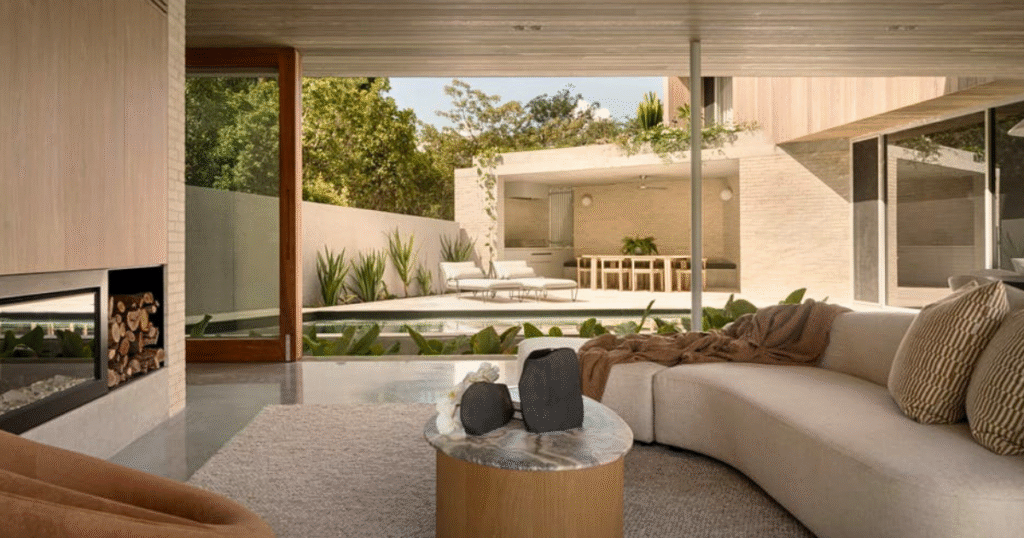
A spatial hierarchy. Which rooms carry the campaign? In most residential properties, the answer is the primary living area, the master bedroom, and the outdoor connection. These three spaces receive the depth of creative investment. Secondary rooms are supported, but the hierarchy of effort should be explicit.
The single-sentence story. Relevant to the styling brief, written on the mood board. Referred to every time a selection decision is being made. If a piece doesn’t serve the sentence, it doesn’t make the cut.

Furniture Selections as Campaign Architecture
This is where strategic styling diverges most visibly from volume staging, and where the commercial furniture inventory a stylist has access to becomes essential to the campaign quality.
Furniture selection at the strategic level is about choosing pieces that perform specific functions informed by the styling brief. It’s critical to find a hire partner that understands how furniture informs spaces and effects buyer decision making.
Scale and Proportion
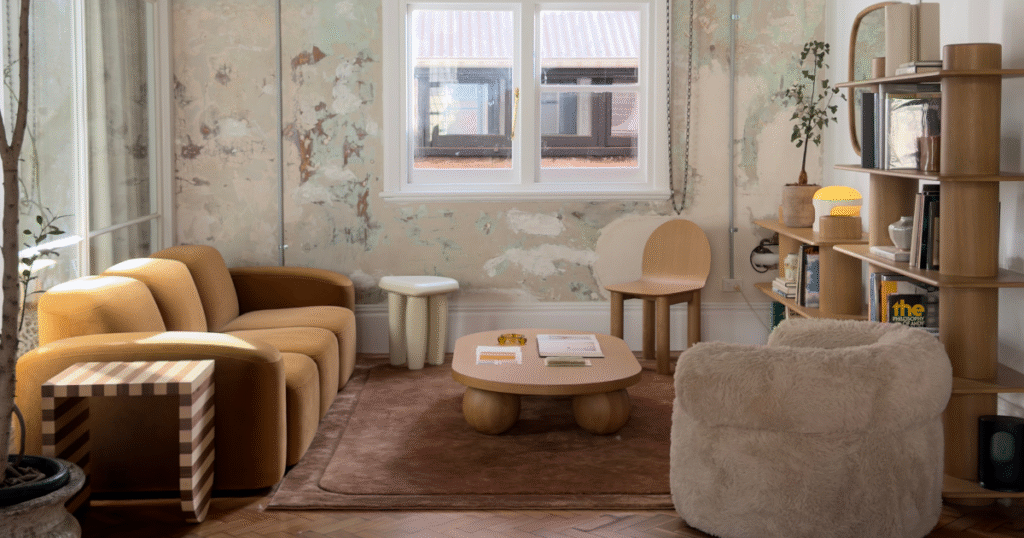
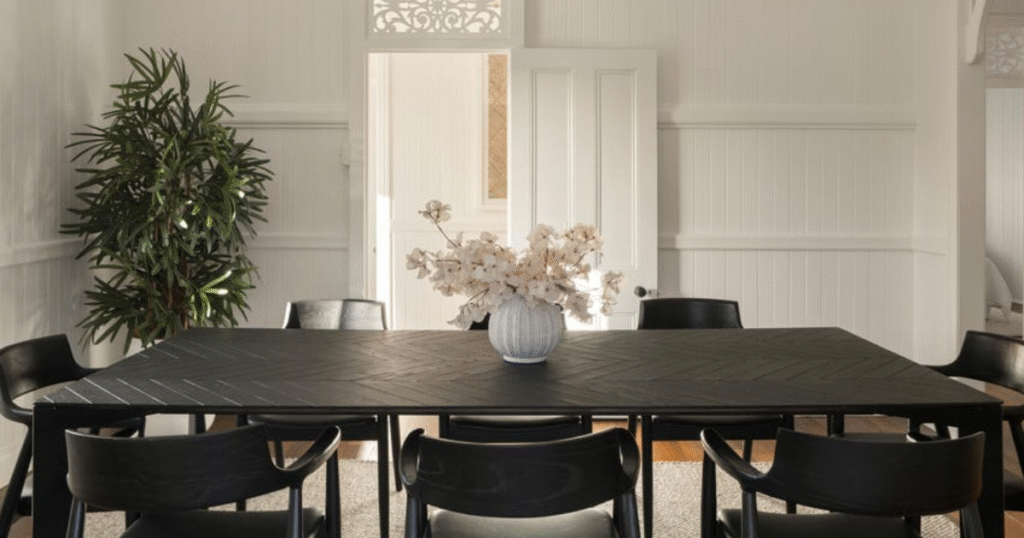
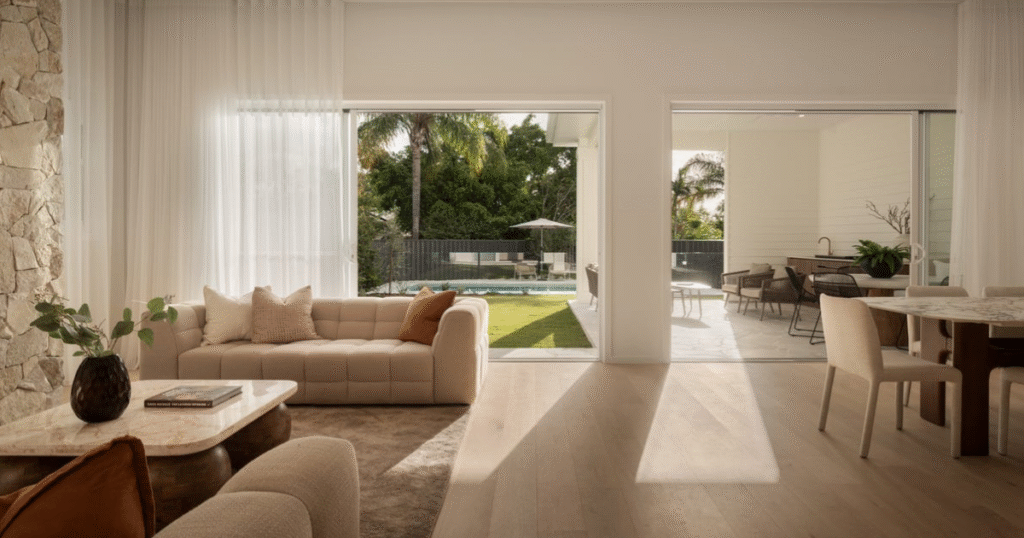
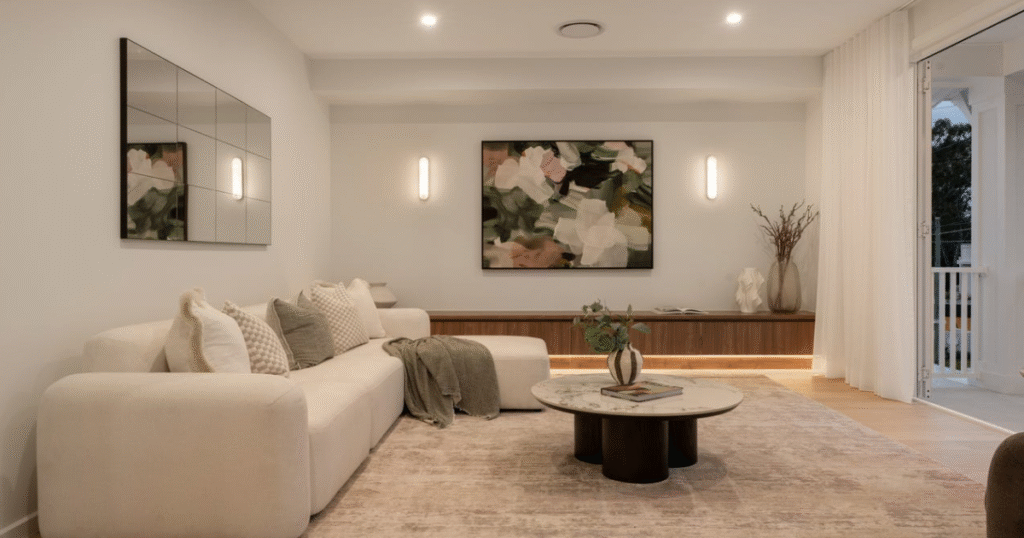
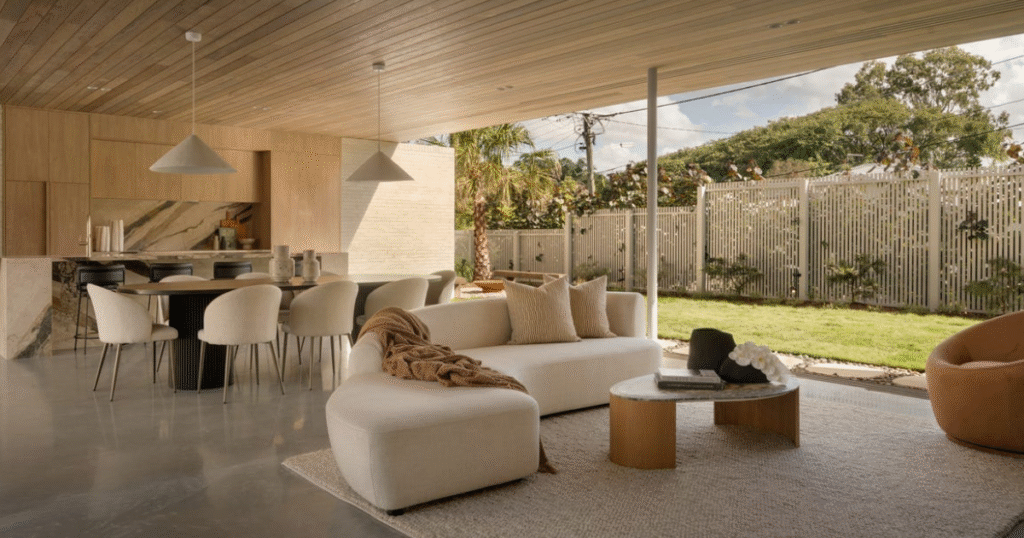
The primary sofa in a prestige living room is not selected because it is comfortable, or even because it is beautiful. It is selected because its scale correctly communicates the size of the room, because its profile photographs with the right weight and presence, and because its material reads as premium, under professional lighting and camera lenses.
This is why commercial furniture hire at the luxury level is categorically different from sourcing domestic pieces or using volume rental stock. The pieces exist to perform on camera and in person.
The Layering Logic
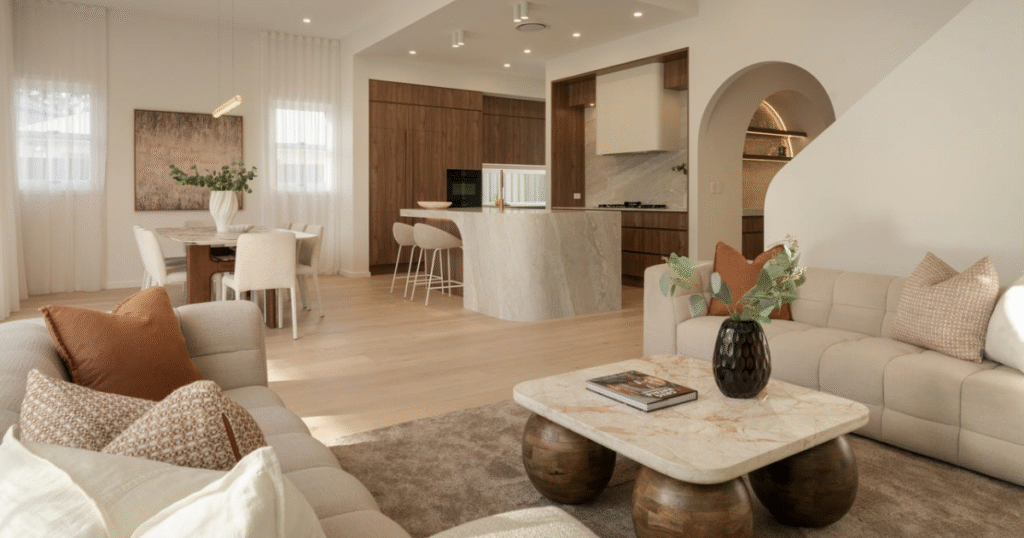
Strong staging is built in layers, and each layer serves a different perceptual function:
- Foundation pieces (sofa, dining table, bed) establish scale and anchor the spatial hierarchy
- Secondary pieces (armchairs, side tables, occasional furniture) create visual rhythm and prevent the static quality that makes rooms look “set dressed” rather than lived-in
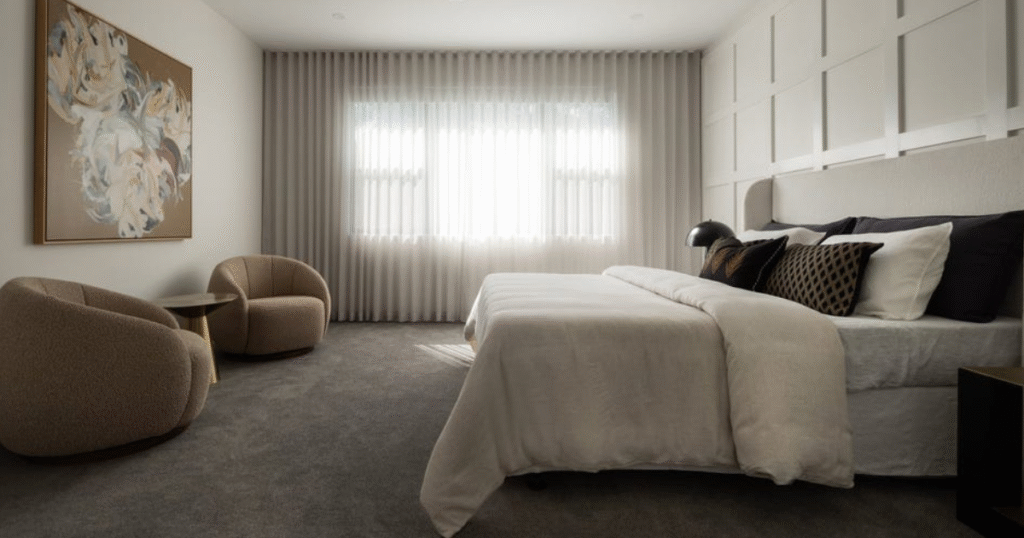
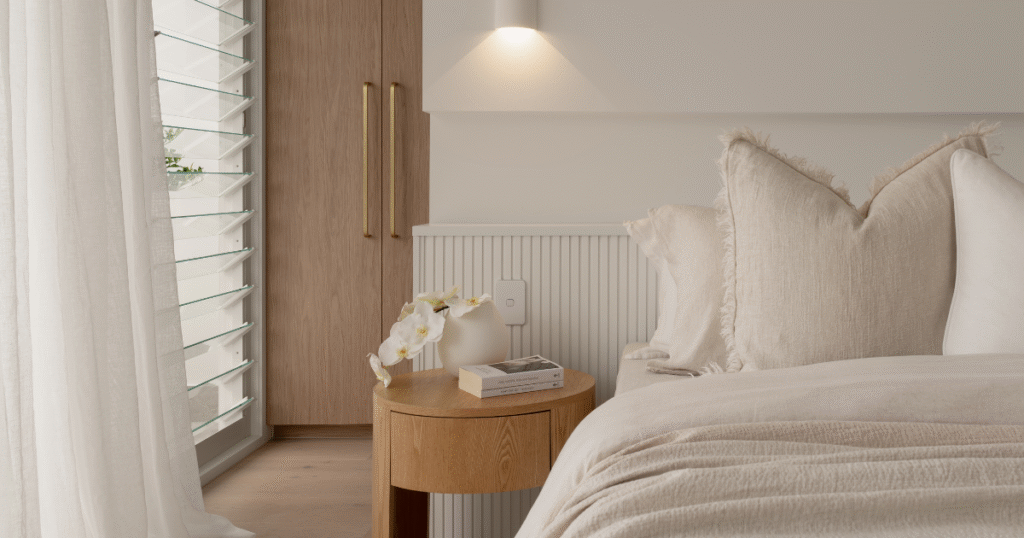
- Textile layer (rugs, cushions, throws) introduces warmth, texture contrast, and the sense of belonging that activates future-self projection in buyers
- Object and art layer communicates the lifestyle identity and cultural alignment with the target buyer profile
Each layer must cohere with the others and with the mood board direction. When any layer is missing or misaligned, the result is a room that doesn’t emotionally capture the intended audience.
The Photography Imperative
In the digital age, every selection decision should be tested against the question: how does this read through a camera lens?
Materials that look beautiful in person may photograph flat. Colours that feel warm and rich in a room can shift cold or grey under certain lighting conditions. The relationship between furniture height and ceiling height, between rug scale and floor area, all of these details affect whether a room photographs with depth and dimension, or collapses into a flat plane on a screen.
A strategic stylist develops this photographic literacy over time. It is one of the most commercially valuable skills in the profession and one of the least explicitly taught.
The first inspection happens online, before any buyer steps through the front door. It is imperative the campaign listing aligns with the styling brief, to anchor potential buyers and convert inspections.

Installation Day as Structured Execution
Installation day is frequently treated as a logistics exercise. For strategic stylists, it is the moment everything comes together, from the styling brief, to selections, to setup.
The Walk-through Sequence
Before the photographer arrives, a strategic stylist walks the property in the sequence a buyer will experience it. From the street, through the entry, through the primary living spaces, to the outdoor connection, upstairs if relevant, to the master suite. They are asking: What does a buyer see as they move from one space to the next? Where does the eye land?
This sequence check frequently reveals micro-adjustments that make significant differences to how a home reads as a whole, rather than as a series of individual rooms. By walking through with the buyer in mind, a stylist can improve sightlines, optimize traffic flow, and ensure the atmosphere is aligned, creating a cohesive and lasting first impression with just a small shift.
Directing Light
Natural light is the most powerful and least controllable element of a property presentation. A strategic stylist understands the property’s light conditions at different times of day. For example, North-facing living rooms photograph best in the morning, where as west-facing master suites come alive in the late afternoon. These key features should be noted by the stylist and capitalised on during installation.
The “inhabitant” principle:
The final check is whether the home reads as inhabited rather than staged. This is a subtle but commercially significant distinction. If a staged home reads as artificial, buyers unconsciously register the effort, which creates distance rather than connection. An inhabited home suggests a life already being lived there and activates the future-self projection that buyer psychology research identifies as one of the most powerful drivers of emotional commitment.
Small interventions create this effect: a book left open, a throw casually draped rather than precisely folded, a coffee table arrangement with an element of asymmetry. None of these things are accidental. They are the last layer of a strategic styling brief that began with a question:
Who is the buyer we are staging for, and what do they need to feel?
A Stylists Creative Vision during Campaign Integration
The stylist’s role does not end at installation. In a fully integrated campaign, the creative vision established in the brief extends through every touchpoint the buyer encounters.
Photography Direction
A strategic stylist should be present for, or closely consulted on, the photographic brief. Hero shots, detail shots, the sequencing of the online listing gallery, are all extensions of the creative direction established in the mood board. A gallery that leads with the master bedroom rather than the primary living space, or that buries the property’s best architectural feature in slide seven, is undermining the campaign, regardless of how well the home was styled.
The online listing is the first inspection. For most buyers, it is the inspection that determines whether there is a second one. Buyer psychology tells us that emotionally charged visual experiences are encoded more deeply in memory, therefore, a gallery that creates a strong emotional sequence is a valuable conversion tool.
Agent Briefing
The stylist’s read on the property, including the story, the buyer profile, and the spatial hierarchy are all valuable assets for the agent conducting inspections. A brief walkthrough conversation before the first open home, covering the three or four moments in the property most likely to stop a buyer in their tracks, is a small investment that can significantly affect how the home is presented, verbally, as well as visually.

The Competitive Advantage that Compounds
There is a compounding effect to strategic styling that changes the conversation a stylist can have about their value.
Every campaign a property stylist runs, produces intelligence. Each execution teaches what works for which buyer profile, exemplifies which furniture selections photograph with the right weight, and informs which spatial interventions shift buyer behaviour most reliably. That intelligence accumulates across projects, and is something that comes from experience. This intelligence sets apart a strategic stylist from a vendor doing their own staging or an agent guessing at presentation. It lives in the stylist’s practice.
A stylist who can articulate this, who can say, with specificity, “across the last five campaigns in this suburb at this price point, here is what I know about what moves buyers” is not just selling a service, but selling a competitive advantage that cannot be replicated any other way.
That creative vision becomes your competitive advantage.
For the specific scripts that bring this positioning into vendor conversations, the Price Objection Playbook has the language ready to use.
Partner with a Furniture Hire Team who works the same way
Premium furniture selected for photographic performance, buyer profile alignment, and spatial impact at the luxury end of the Brisbane and SEQ market.
If you’re a stylist, agent or Airbnb operator and you want a furniture partner who understands the styling brief and the process that follows, we’d love to work together.
Frequently Asked Questions About Commercial Furniture Hire
Who typically uses furniture hire services?
Furniture hire is commonly used by property stylists, real estate agents, developers, photographers, production companies, event organisers and property investors.
Is furniture hire only for home staging?
No. While home staging is one of the most common uses, furniture hire is also used for film production, marketing shoots, rental properties and events.
Is hiring furniture cheaper than buying it?
For short-term use, hiring furniture is usually far more cost-effective than purchasing it, especially when transport, storage and styling changes are considered.
Where is furniture hire most common in Queensland?
Furniture hire is widely used across Brisbane, Gold Coast, Sunshine Coast and Toowoomba, particularly in property marketing and creative industries.
Related Reading
Want to learn more about what buyers feel when they walk into a staged home? Discover the key buyers psychology frameworks that inform emotion and drive offers in the spaces you create.
Buyers feel before they think. Staging controls what they feel.